Exhibition

Title: Like Father

Producer: Amber Films

Exhibits: 2 (view by pages)

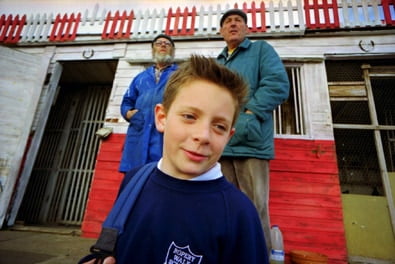
The second film in Amber's coalfield trilogy, a feature drama exploring the lives of a grandfather, father and son, as they come to terms with the post-closure landscape of East Durham. See a video clip

Hope, humour and rugged beauty amid the bleakness... Independent on Sunday

Available as VHS ..more »

Related items

Like Father

Amber Films (Producer)

94 mins, 35mm
Colour/optical
Feature film
Available as VHS

*Golden Sun, Best Feature Film,
International Environmental Film Festival, Girona, Spain, 2002*

Like Father portrays a family in crisis, focusing on the dislocations of grandfather, father and son. Pigeon man Arthur Elliott, a 70 year-old whose working life in the pit gave him a strong sense of identity and pride, is losing his allotment to the local authority's coastal redevelopment scheme. Working as a trumpet player, a teacher and a club singer, as well as running an agency for club acts, 40 year old, ex-miner, Joe Elliott can just about scrape a living out of his music, but he is losing his wife. 10 year old Michael Elliott, who is living with the pit village folklore and the wreckage of the coal industry, is left to grapple with his own realities. Each of the three generations is struggling to come to terms with the past and find the ties that bind them. The three separate, but essentially integrated worlds, unfold against the rich and extraordinary backdrop of East Durham's landscapes and locations.

It is the second film in Amber’s coalfield trilogy. The Scar (1997) explored the lives of women in the aftermath of the failed Miners’ Strike of 1984, and the closure of Durham’s last pit in 1993. The third film, Shooting Magpies (2005) looks at the post-industrial generation, and the impacts of heroin in the colliery villages of East Durham.

Development of Like Father began in 1998. Its dramatic content originated from actual lives and the unfolding of real events. Incorporating documentary situations, the film features strong performances from both professional and non-professional actors alike. Strongly committed to nurturing latent natural talent, Amber took the bold step of casting local people with no previous acting experience in each of the three main roles: Ned Kelly as Arthur; Jonathon Dent as Michael; and Joe Armstrong, who himself an ex-miner, plays Joe, and wrote the brass band suite which features in the film as a commission for his character.

AMBER FILMS
Made with the financial assistance of the BBC.

Cast Includes: Joe Armstrong, Ned Kelly, Jonathon Dent, Anna Gascoigne

REVIEWS
The quality of all the performances - notably the amateurs, led by Joe Armstrong - is first rate, and they are matched by the cinematography….. At times this looks the best place in the world. The music, too, much of it composed in real life by Joe Armstrong, adds to the film's compelling atmosphere. Some will compare this film with Billy Elliot but that was fantasy. This reeks of the truth. It is one of the best films of the year. * David Whetstone, The Journal

Engaging intimate cinema and the dramatic north-eastern coastline is terrifically photographed …. This is a warm, human film. Peter Bradshaw, The Guardian

A love triangle of a different sort, Amber's latest broaches the potentially fraught subject of modern masculinity with a beautifully leavened story of a family's three generations of men. Like Father's simple structure touches upon a remarkable array of issues and experience. The wonder is that it's so lightly achieved: the films treatment of concerns as seemingly far-flung as boyhood rivalry and civic corruption, attention-span deficiency and the fate of the natural landscape is so subtle, you'd be more likely to miss the point altogether than find it in any way dogmatic….. there's a vivid beauty here, and a pang of melancholia in the recognition of the loneliness that's concomitant with men's social instinct. Nick Bradshaw, Time Out

Like Father is committed, realist film-making, with all the courage of its considerable conviction…. This is tremendously affecting and effective, the actors, give terrific, impassioned performances, especially Joe Armstrong, whose character grows in dignity and stature as his own life disintegrates around him, and has a tragic dimension appropriate to the big screen. Low on budget, but high on intelligence, why can't we have more Brit films like this? filmfour.com

Like Ken Loach at his most effective, Amber show an ability to successfully marry realism and melodrama, the stirring music in this case being provided by the brass band for whom Joe writes various compositions. Neither patronising nor idolising its characters, and with a dry humour, Like Father also allows its various themes - such as class conflict, the clash between traditions and progress, and the burden of the past - to develop organically from the story line. And the supremely convincing performances …. Ensure that it never descends into dour dogma and remains a flesh - and - blood tale of ordinary dignity and pride. Tom Dawson, carlton.com

This enthralling drama focuses on a working-class family in East Durham. The central theme is the heart's longing for emotional sustenance, and the film does its bit to satisfy this need in its viewers. Edward Porter, The Sunday Times

A winning authentic slice of family life set against the rough beauty of the former East Durham coalfield. The mainly non-professional cast turn in strong, naturalistic performances; as the film's amiable, put - upon central figure, Armstrong is particularly fine. The Times

Like Father is unabashedly concerned with intergenerational, crisis-hit masculinity. Michael starts to disdain his beleaguered dad for the company of the pigeon men (there's a tremendous moment when a distressed Jackie hands down his cherished catapult to the boy). The production is dedicated to the comic Willie Ross, who died of a brain haemorrhage during filming. Like Father permits Ross fans one lovely last chance to cherish his cock-eyed, stiff-legged imitation of inebriation. For this and umpteen other reasons, Like Father is a genuine treasure,worth ten of Billy Elliot. Richard Kelly, Sight & Sound

Not short on the feel-good factor itself - the swell of the brass band and the sight of thousands of pigeons being liberated for a race knock the socks off Billy Elliot's gooey sentimentalism - Like Father is a responsible film that also manages to be deeply likeable. While teams like Amber continue to produce work of this calibre, non-mainstream British film will remain in rude health. Emma Sturgess, Metro

A familiar but intensely rendered portrait of a former mining community in East Durham, northern England, 'Like Father' brooks no sugar-coating as it examines the messy consequences of de-industrialization. Social and familial divisions are convincingly depicted thanks to three fine non-pros in the lead roles. Detractors may damn earnest venture as bargain basement Ken Loach, but pic fiercely champions ordinary people who prefer to remain in their hometown rather than head off for the big city. Lisa Nesselson, Variety

This naturalism is what ensures the film isn't unremitingly grim-oop-north. As in real life there is hope, humour and rugged beauty amid the bleakness. Nicholas Barber, Independent on Sunday

As Joe Eliot, ex-miner, trumpet player and troubled family man, Joe Armstrong gives a likeably rounded performance. I hope we see more of him. Anthony Quinn, The Independent

A non-professional cast shine in this superbly photographed low-key drama. The Independent

Alongside Ken Loach, Amber are the last great (working) class warriors of British film... You watch an Amber film and you are convinced you are eavesdropping on real lives. Simon Hattenstone, The Guardian

THE MAKING OF LIKE FATHER
In 1992, we began a change of emphasis away from an urban focus into the more rural environment of the villages of the East Durham coalfield, where the closure of the mines was having a dramatic physical and social effect. A number of projects have already been completed, including the feature films, Eden Valley and The Scar.

The film Like Father started to unfold while making The Scar. The development of dramatic film ideas has often taken place alongside the unfolding of real events. Films are set in real places, incorporating real experience. The Scar deals essentially with a woman's perspective of the impact of industrial closures on her community. With Like Father we explore the issue of how masculinity develops within a declining industrial area.

With that as our starting point, we set out to raise a film budget. This was achieved with funding from the BBC, the Lottery, and Northern Arts. Our contracts cover research, development, production, post-production and distribution. The project began in February 1998, with a delivery date in September 2000. The budget is approximately £500,000.

Our research started with video interviews, men and boys within three specific age ranges - over 60, between 30-40 and 9-11 years old. We produced over twenty hours of interview material on video. From this material a dozen stories could have been told. Narrowing this down to the development phase was not easy.

We moved on by training three 70 year old men in how to use a video camera, setting them off to make a record of their own lives and concerns. They focused on the allotment gardens which they had carefully tended for most of their adult lives, and which they had been served notice to quit. The result was remarkable and inspirational, and their story has become a major element of the film story line.

From our interviews within the 30-40 age group, we found an extraordinary man, Joe Armstrong. We decided to test his ability to perform in front of the camera by recording his daily life. Once we were sure we had found a "performer", we allocated to Joe one of the main parts in the film, representing the middle generation.

To develop the character of the 9-11 year old, we ran a drama group in Seaham over the 1988 summer holidays. With the help of friends who ran a local summer scheme, six lads were selected for the group, five ending up in the film. Sadly the sixth was diagnosed as having leukaemia during this period and had to withdraw (see the photography project Fathers by Peter Fryer ).

Filming started in February 1999 and finished in the beginning of 2000. Tragedy struck our shoot in May; Willie Ross had been engaged for a week contract. He arrived as planned, completed rehearsals and one-day filming, during which he was on great form. On the Tuesday evening he took ill at his hotel and was admitted to hospital with a brain haemorrhage. He never regained consciousness and died on Saturday the 12th of February. We were all devastated by his death, but also privileged to meet his immediate and extended family and friends. Through them we discovered what a rich and varied life he had. His funeral was a real celebration of his life, and in keeping with this we used the scene we shot with him in the film.

Add your comments

You must be a registered user to add comments. Click here to register, or log in using your account details.